The Electronic Lab Notebook That Structures Your Science

SciNote is an electronic lab notebook built for the full complexity of scientific research, featuring structured workflows, connected inventory, team collaboration, compliance tools, and integrations that bring your instruments and systems into a single, coherent platform.
When every experiment, protocol, sample, and result lives in the same structured environment, your lab gains something that is hard to manufacture any other way: a complete, trustworthy record of how the science actually happened — one that is searchable, shareable, and built to last.
What would it mean for your lab if every piece of scientific work was permanently connected to everything that produced it?
What SciNote’s ELN Delivers
SciNote delivers an integrated range of capabilities that modern labs need to operate with precision — experiment documentation, protocol management, inventory tracking, project visibility, compliance tools, workflow automation, and software integrations — all within a single platform designed so that each capability strengthens the others.
Compliance Standards
SciNote’s electronic records and signatures architecture satisfies FDA requirements for regulated lab environments — with immutable audit trails, identity-verified e-signatures, and role-based access control built into every workflow.
SciNote supports Good Practice workflows across research, manufacturing, and clinical environments — with structured documentation, SOP enforcement, and traceability that meets GxP expectations at every stage of the scientific process.
SciNote’s security architecture is certified to ISO 27001:2022 standards — with encrypted data storage, secure access controls, and audit-logged user activity across your entire lab operation.
MaxCyte, Biopharma R&D
A growing biopharma R&D team needed a platform that could scale with their science — connecting experiment documentation, protocol management, and team collaboration in a single environment that would hold up under regulatory scrutiny and grow with the complexity of their programs. SciNote gave their researchers a structured workspace where every experiment was part of a connected program record, and every result was traceable to the protocol and the team member who produced it.
“SciNote is simple to use, enabling fast data entry, effective data management, and support for project and inventory tracking. Its strong searchability has improved our productivity and helped us better support partners, customers, and internal teams across marketing, commercial, and product development.”
Outcome: Faster R&D execution, cleaner documentation, and a data foundation built to support the next stage of development.
This is what it looks like when experiment records, protocol libraries, inventory tracking, team assignments, and compliance documentation all live in the same structured environment.
Key Functionality
A structured Project / Experiment / Task hierarchy that organizes scientific work at every level of complexity — from a single experiment to a multi-team R&D program — with full traceability connecting every task to the protocol, the data, and the person who did the work.
A connected inventory system that links every reagent, sample, and consumable directly to the experiments that use them — with lot tracking, storage locations, stock alerts, barcode scanning, and label printing built in.
A compliance architecture that is present at every layer of the platform — immutable audit trails, identity-verified electronic signatures, role-based access control, and validated deployment options — so that regulatory readiness is the byproduct of how the lab works, not a separate project to be managed.
There are a lot of electronic lab notebooks. The difference between a platform that labs adopt and then quietly work around, and one that becomes the actual system of record for their science, comes down to whether the people who built it understood what scientific work really requires.
SciNote was built by a team that holds itself to a high standard of craftsmanship and that stays close to how labs actually operate. The product evolves in response to real needs. Features are thought through to their logical conclusion, documentation is honest, and the support team treats customer feedback as information to act on.
The result is a platform where the capabilities do not just coexist, they connect. The inventory is linked to the experiment. The experiment is linked to the protocol. The protocol is linked to the compliance record.
That coherence is what makes SciNote a system of record rather than a collection of tools.

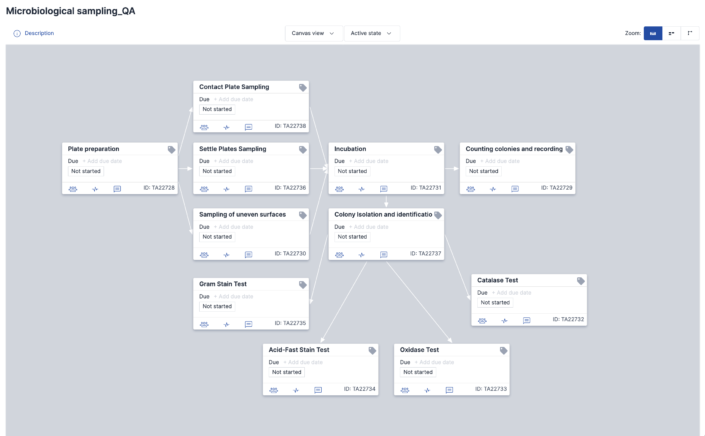
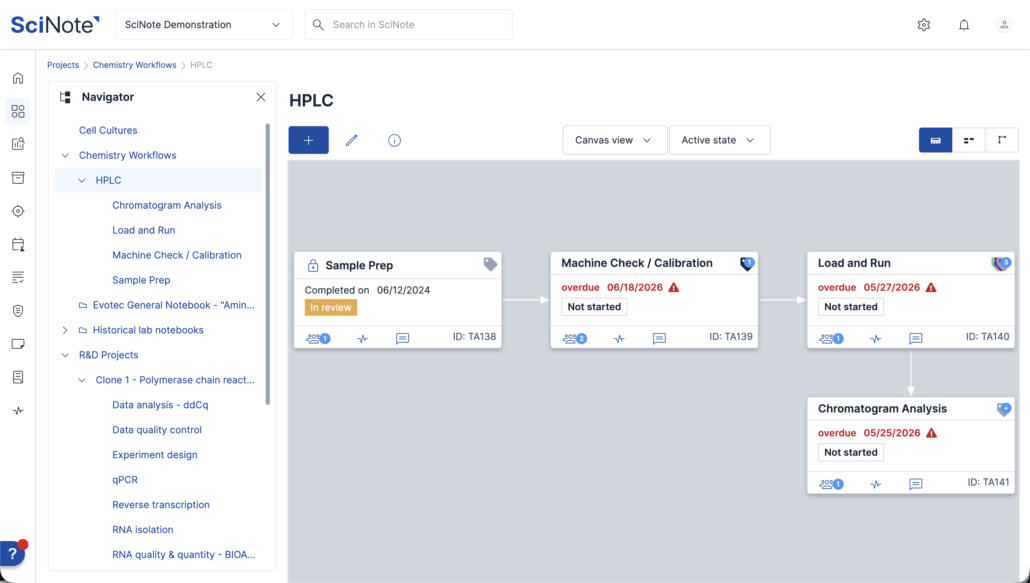
SciNote organizes scientific work in a Project / Experiment / Task hierarchy that scales from a single researcher’s daily documentation to a multi-team R&D program spanning years. Within each experiment, researchers document results, attach files, complete guided protocol steps, annotate with smart links to inventory items and team members, and log every action in a tamper-proof activity record. The platform supports both linear and non-linear workflows, structured data entry through customizable forms, and visual workflow planning in a project canvas.
Every experiment your lab runs becomes part of a searchable, connected record — organized by the structure of your science, not by whoever happened to file it. New team members can find the full history of a project from their first day. Collaborators can see exactly what was done and when. And the record that an auditor or a reviewer needs is already complete, because it built itself as the work happened.
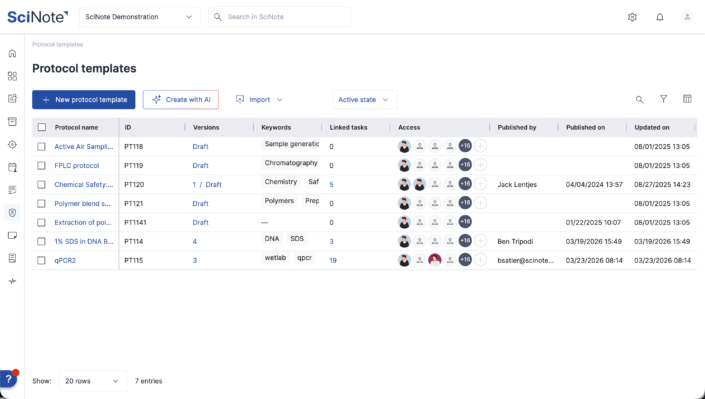
SciNote’s protocol library stores SOPs and experimental methods as structured, version-controlled templates — with required completion fields, guided step sequences, and full version history. Import existing protocols from PDF using AI parsing, build from scratch with templates, or adapt a colleague’s method and track the variation. SciNote Forms enables structured data collection within protocols — with custom field types, required entries, and form-level electronic signatures.
The method your team spent months optimizing is available to every researcher in the lab, in the same form, from the first time they log in. Protocol versions are explicit: everyone knows which method they are following and what changed from the last one. And the data collected within each protocol is structured from the moment it’s entered, which means it’s searchable, exportable, and ready for analysis without additional preparation.
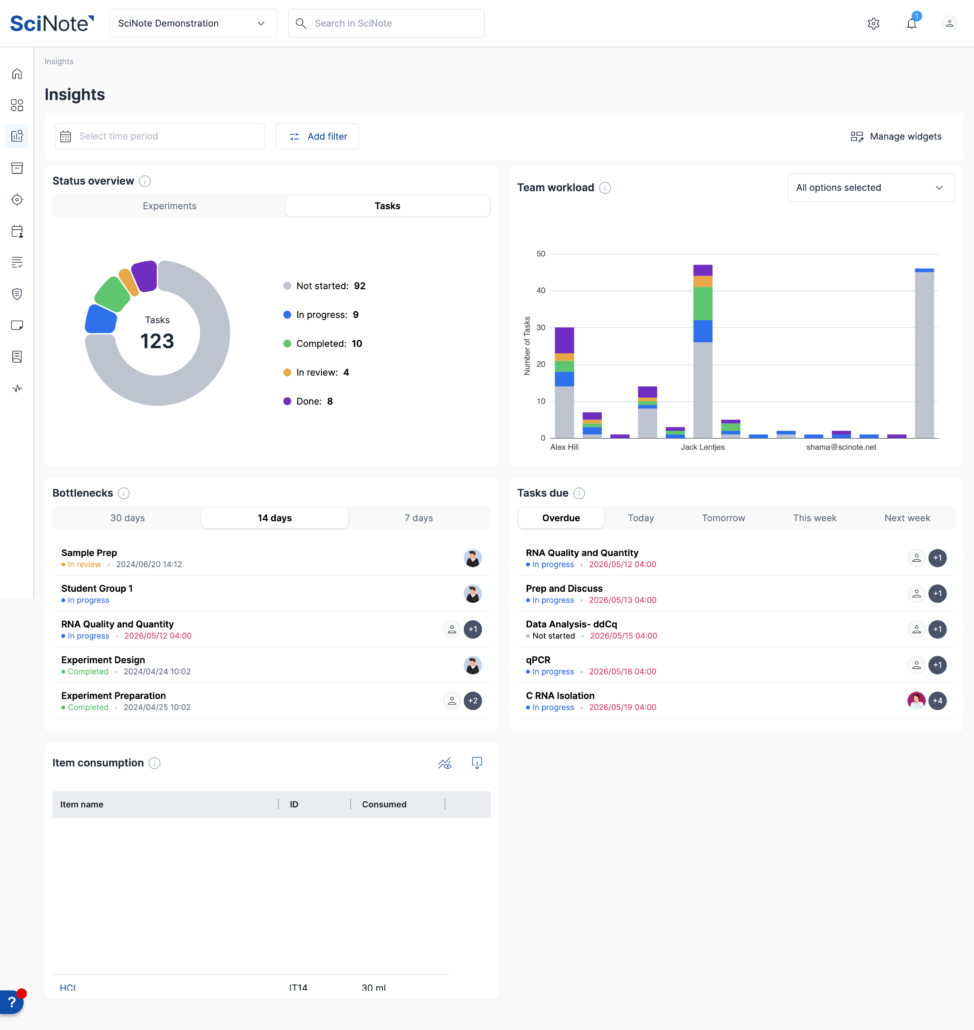
SciNote’s Project Insights dashboard gives lab managers and R&D leads a real-time view across all active projects – task status by team member, progress against milestones, resource allocation, and overdue items – without requiring a status meeting or a manual report. User roles and permissions give administrators granular control over who can view, edit, complete, or approve work within each project. Reviewer workflows, comment threads, notifications, and user groups support scientific collaboration at every scale – from a two-person team to a multi-site research organization.
The coordination overhead that typically falls on the lab manager – tracking what is done, following up on what is overdue, reconciling who did what and when – moves into the platform, where it belongs. Lab leaders gain the visibility to make decisions based on the actual state of their programs, and researchers gain the clarity to focus on the work rather than the communication around it.
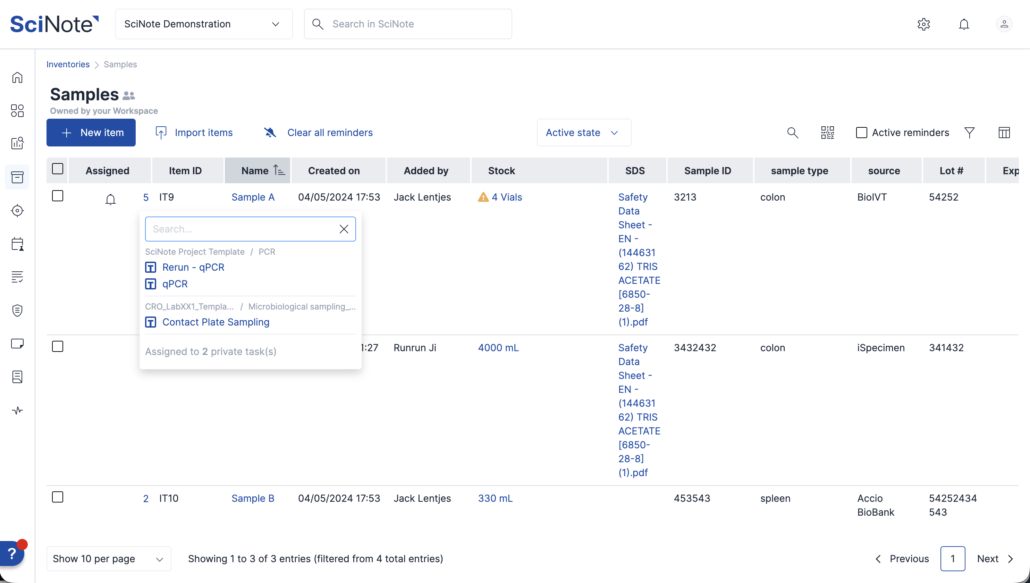
SciNote’s inventory system tracks reagents, samples, consumables, and equipment with lot numbers, expiration dates, storage locations down to the box level, and usage history linked directly to the experiments that consumed them. Stock alerts, barcode scanning, QR code generation, and label printing with compatible printers are built into the platform. Inventory items can be imported in bulk, linked across projects, and exported with full usage logs for audit or compliance purposes.
The connection between what is in your inventory and what is in your experiments is maintained automatically. Every inventory action is part of the scientific record.
SciNote’s workspace automation engine allows labs to define rule-based triggers that automatically route tasks, update statuses, send notifications, and create follow-on actions based on conditions set by the lab. Automation rules are configured without code — through a visual rule builder that translates lab process logic into platform behavior. Combined with SOP-guided task templates and required completion fields, automation reduces the coordination overhead that falls on team members and ensures that process-critical steps are never skipped.
The task that needed to be manually handed off to the next person in the process now routes itself. The notification that someone needed to send to flag a completed step is now sent by the platform. The lab’s process logic lives in the system. It’s consistent, repeatable, and independent of whoever happens to be in the lab that day.
SciNote’s RESTful API enables bidirectional data exchange with external platforms — including QMS systems, ERP tools, data analysis environments, and sponsor data repositories. Webhooks support real-time event-driven integrations. Native integrations include Ganymede for instrument connectivity and live data routing, Gilson IoT for direct instrument control, protocols.io for protocol import and sharing, Quartzy for inventory synchronization, and Microsoft Office for document embedding and editing within SciNote tasks.
SciNote connects to the instruments and systems your lab already uses — so data flows into your experiment records rather than being manually transcribed from one system into another. The ACD case study demonstrates what this looks like at scale: a multi-client CRO that automated its entire study onboarding and data routing workflow through SciNote’s API, eliminating administrative overhead that had previously required a dedicated person to manage.
Built For
Book a demo with the SciNote team.

Main benefit and reason for having an electronic lab notebook is the creation of a searchable database, accompanied by significant time savings.
— Jonas Kosten, Division Leader Analytics, NEUWAY Pharma, DE
FAQ
An electronic lab notebook is a platform for documenting and managing scientific work in a structured, searchable, and shareable digital environment. SciNote goes beyond basic documentation to deliver connected capabilities across protocols, inventory, project management, compliance, automation, and integrations — all within a single platform where every element of the scientific record is linked to the others.
Yes — SciNote’s compliance architecture includes immutable audit trails, identity-verified electronic signatures, role-based access control, and validated deployment options that support 21 CFR Part 11, GxP, and EU Annex 11 requirements. Platinum plan customers receive full validation documentation packages with every release.
Yes — SciNote is designed for labs managing multiple parallel programs, with separate project workspaces, shared inventory, role-based permissions, and a Project Insights dashboard that gives lab leaders visibility across all active work at once.
All data in SciNote — experiments, protocols, inventory records, and documentation — remains in the platform and accessible to the lab after a researcher’s account is deactivated. Scientific knowledge stays in the institution, not with the individual.
SciNote is available as a cloud-hosted platform and as a local (on-premise) installation for organizations with specific data sovereignty, security, or compliance requirements. An open-source version is also available for academic and institutional environments that prefer a self-managed deployment.
SciNote delivers the core capabilities that labs evaluate LIMS for — sample tracking, workflow automation, inventory management, compliance, and reporting — integrated within a broader platform that also includes ELN functionality, protocol management, and team collaboration. For a detailed comparison, the LIMS vs ELN guide is a strong starting point.
SciNote’s onboarding includes a dedicated Customer Success Manager, structured training resources, and access to an active user community. Most labs are running live experiments in SciNote within their first week. SciNote’s team does not charge separately for onboarding support — it is included with every account.


Receive SciNote ELN news, webinars and articles.


