AI Starts with Research Data: How SciNote ELN Prepares Your Lab for Impactful AI
 5 min read
Artificial intelligence is powering major advances in drug discovery, diagnostics, and precision medicine. But despite the hype, AI is only as good as the data it’s trained on. And in the context of lab research, that means having clean, structured, and contextualized experimental data—something most spreadsheet-based labs can’t provide.
That’s where lab management systems (LIMS) and electronic lab notebooks (ELNs) like SciNote come in. For any AI system to extract meaning from scientific workflows, it needs data that’s consistent, traceable, and machine-readable. SciNote delivers exactly that.
A standout example: Turbine.ai, a company virtualizing biological experiments to accelerate drug development, relies on SciNote to feed its AI simulation platform with structured, experiment-level data. Whether you’re working in biopharma R&D, diagnostics, CDMO operations, or medical device development, this is your blueprint for making AI work—by starting with better data.
Why Having an ELN Is a Prerequisite for Effective AI Use in the Lab
AI models—from machine learning classifiers to deep learning simulations—require quality data to yield valid predictions. Unfortunately, experimental data in many labs is stored in unstructured formats at best: free-text notes, inconsistent Excel files, or non-standardized protocols, or at worst – are handwritten on pages of a physical notebook.
Before data scientists can even touch a model, they often need to spend weeks cleaning, validating, and aligning datasets. That’s a costly delay and a risk to data integrity.
Lab management systems like SciNote solve this by giving labs a single platform where:
This makes the downstream application of AI not just possible but scalable.
How Turbine AI Uses SciNote to Power Its AI Engine
Turbine.ai simulates cellular behavior and disease models to help pharmaceutical companies identify the most promising targets early in the R&D pipeline. Successful simulation requires consistently captured biological data from the lab, entered by scientists, used by AI.
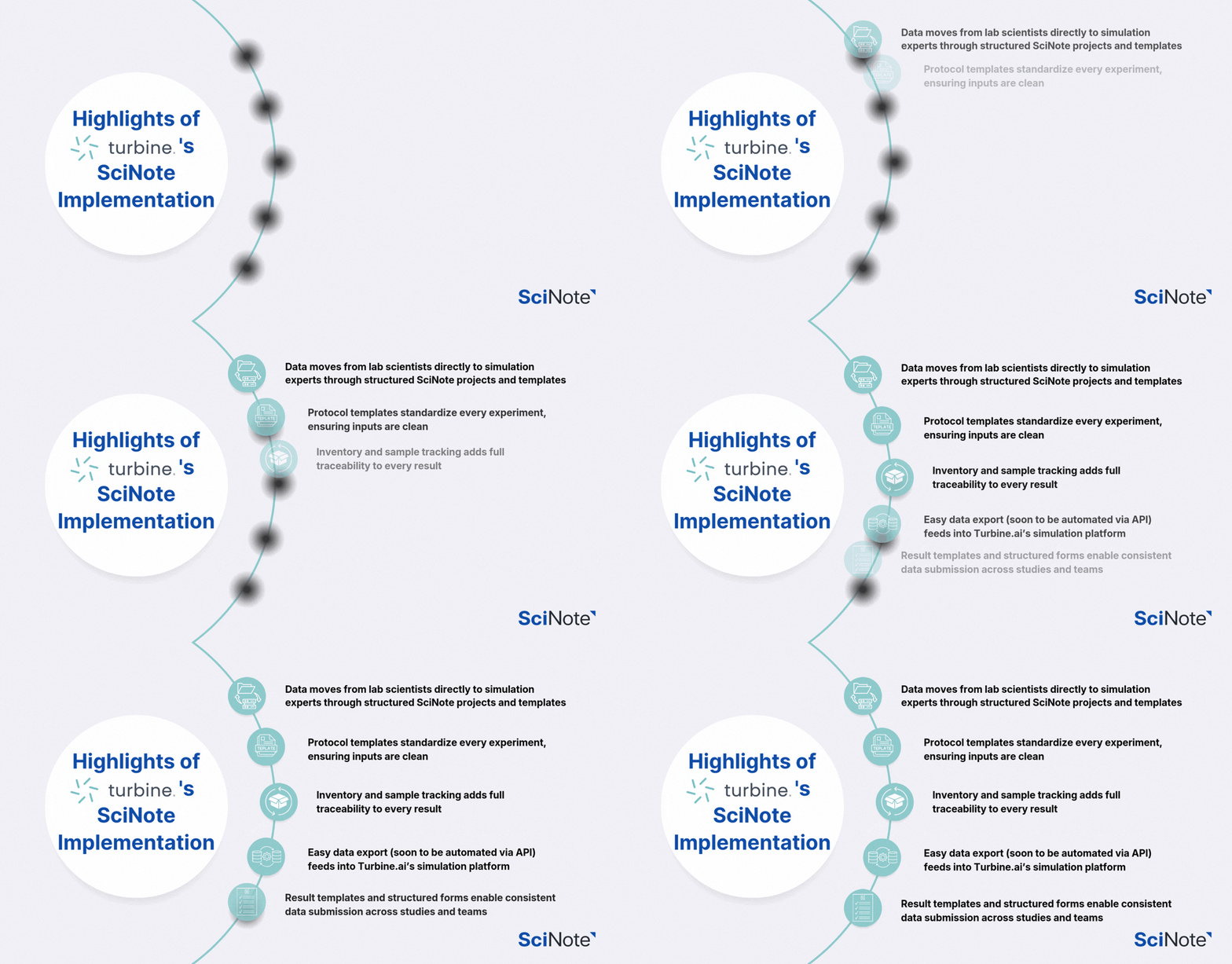
In Turbine.ai’s own words:
“SciNote has provided a protocol template that allows us to standardize how we load data at the end of each project… Even though full automation is not yet in place, SciNote’s suggested workaround lets us enter new data in Excel-based templates, approve the tasks, and then the Simulation team pulls it using the API.”
How Standardized Templates Improve AI Data Quality
Standardized templates are one of the most powerful data quality tools in SciNote and they matter deeply for AI.
Here is how:
1. Consistent Data Capture
Templates enforce that the same information is collected the same way every time. This reduces variability and errors across experiments.
AI Benefit: Easier data merging and less pre-processing needed for model training.
2. Metadata Enforcement
SciNote allows required fields, dropdowns, units of measure, and tags—applying FAIR data principles at the point of entry.
AI Benefit: Improves machine readability and context integrity.
3. Version Control
Templates link protocol steps with reagents, instruments, and samples inside SciNote’s inventory system.
AI Benefit: Provides rich, structured feature sets for modeling and simulation.
4. Minimal oversight into real-time progress
Protocol versions are tracked and linked directly to data outcomes.
AI Benefit: Enables reproducibility and lets AI/ML tools account for procedural differences over time.
Examples of AI Application That Benefit from SciNote Data
Once your lab data is AI-ready, you unlock advanced capabilities like:
Virtual Experimentation (e.g., Turbine.ai)
Real-world lab data can be used to simulate disease models and drug interactions, helping teams predict drug responses and identify promising targets earlier in the discovery process.
Predictive QC and QA in Manufacturing
Lab-generated data can train models to detect trends and deviations in GMP environments, allowing risks to be identified sooner and scale-up conditions to be optimized with greater confidence.
Sample Optimization Models
By analyzing usage patterns and demand trends, AI can help optimize inventory levels, reducing material waste while ensuring critical supplies are always available.
Intelligent Protocol Optimization
Aggregating results across protocol versions makes it possible to pinpoint the most effective experimental conditions and continuously refine lab processes using structured feedback.
Trial Simulation and Target Selection
Preclinical data from SciNote can support patient stratification and trial design through simulation, helping teams reduce risk and define clearer, more effective trial criteria.
Ready to Build an AI-Ready Lab?
Whether you’re still planning your first AI initiative or expanding automated analyses, here’s what to do:
- Centralize your experimental data in a system like SciNote
- Define and enforce standardized templates and metadata fields
- Link inventory and outcome data to individual experiments
- Enable audit trails and electronic signatures for compliance
- Connect to your analytics tools via SciNote’s RESTful API for real-time exports
Together, these practices produce AI-grade datasets without changing how your scientists work.
Takeaways: Operationalizing Laboratory Experimental Data for AI
AI success isn’t determined by your algorithm, it starts with your data. SciNote acts as the bridge between experimental science and computational discovery. By empowering every step of the data lifecycle from template-enforced capture, to traceability, to seamless export. SciNote ensures your lab produces data that’s as ready for review as it is for simulation.
Just like Turbine.ai, your organization can cut manual errors, standardize data entry, and fuel a faster innovation pipeline powered by reproducible science and predictive modeling.
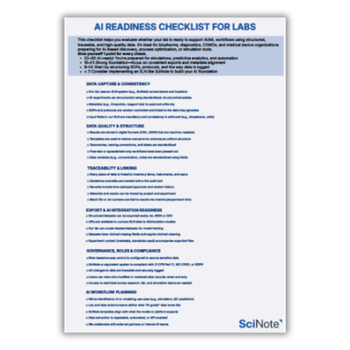
Download our AI Readiness Checklist for Labs
Request a personalized demo
to see how SciNote supports AI pipelines and product development.


