Powering Brain Tumor Biobanking: SciNote Connects Slovenia’s Cancer Research Community
 4 min read
Biobanks are no longer just freezers filled with samples. They’re dynamic, data-driven platforms that power translational research and precision medicine. In diseases as complex as glioblastoma, success depends on more than cell lines and tissues: it requires structured data, sample traceability, and coordinated knowledge management and collaboration across clinical and research teams.
This is exactly what the National Institute of Biology (NIB) and their partners set out to address with GlioBank, Slovenia’s centralized glioblastoma biobank platform. At the heart of their effort is SciNote, the electronic lab notebook (ELN) and inventory management system that brings harmonized data and biospecimen processes into one secure system across interdisciplinary teams, powering translational medical research.
Content
What is the GlioBank?
GlioBank is a disease-specific biobank for glioma and glioblastoma patient samples which established through national inter-institutional collaboration. It links several major research institutions across Slovenia:
- National Institute of Biology (NIB)
- University Medical Center Ljubljana (Departments of Neurosurgery and Neurology)
- Faculty of Medicine, University of Ljubljana
- Institute of Radiology at the Faculty of Medicine, University of Ljubljana
- Institute of Pathology at the Faculty of Medicine, University of Ljubljana
- Institute of Oncology, at the Faculty of Medicine, University of Ljubljana
GlioBank stores and manages:
- Resected tumor tissues biopsies
- Blood plasma and peripheral mononuclear cells
- Patient-derived cell models, including glioblastoma stem cells (GSCs) and organoids
- Clinical, pathological, molecular, and experimental data
This powerful collaboration, supported by structured digital workflows in SciNote, enables researchers to ASK and ANSWER some of the most urgent questions in glioblastoma biology.
About glioblastoma:
Glioblastoma is an incurable cancer, and the most aggressive primary brain tumor in adults, with an extremely low survival rate of glioblastoma patients (only 5 to 10 % of patients surviving past 5 years). This essentially means that the current treatments are ineffective, mostly due to the cellular and molecular heterogeneity of the cells that make up glioblastoma tumors, thus creating an immunosuppressive environment which limits the efficiency of immunotherapeutic approaches. As a brain cancer, glioblastoma tumors lie behind the protective blood-brain barrier, which consequently acts as a major obstacle, significantly reducing the effectiveness of most treatments. And lastly, the fact that glioblastoma is not frequent enough in the population makes it unattractive for commercial drug development and pharma companies to invest in novel treatments.
The Challenge of Collaborative Biobanking
Multi-institutional research presents complex challenges:
- Teams work in different locations under different regulations
- Data is captured in different ways in different locations using different vocabularies
- Biospecimens need strict labeling and LIMS-style organization
- Samples require secure storage, real-time tracking, and linkages to clinical outcomes
- Collaboration between teams is a challenge
- Research and clinical data are dislocated
Without a unified approach to biobanking software, it’s easy for high-value research data to become fragmented, error-prone, or non-reproducible.
How SciNote Supports the GlioBank Workflow
To streamline efforts, GlioBank adopted SciNote’s digital lab notebook and inventory tracking system as a centralized data solution. Here’s how SciNote helps coordinating data, teams, and biospecimens across GlioBank’s research network:
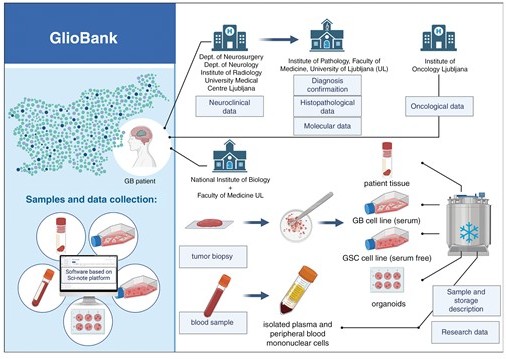
Figure: Schematic presentation of the GlioBank platform and representative images of cell cultures and tissues. (A) GlioBank is a collection of biological samples and neurological and clinical data (provided by the Department of Neurosurgery, Department of Neurology, and Institute of Radiology, all at the University Medical Center Ljubljana), histopathological and molecular data (provided by the Institute of Pathology, Faculty of Medicine, University of Ljubljana), and oncological data (provided by the Institute of Oncology, Ljubljana). Tumor tissues were collected at the time of surgery and stored in tissue banks. Part of the tissue was further processed to establish GB cells, GSCs, and GB organoids. GB, glioblastoma; GSC, glioblastoma stem cells. The image is taken from the published article https://academic.oup.com/noa/article/7/1/vdaf015/7972534
1. Centralized Data Storage
All clinical, pathological, molecular, and experimental data is stored centrally in SciNote either in cloud or on-premise, accessible to each contributor depending on their defined user roles and permissions. This removes data silos and supports real-time teamwork across locations and institutions.
2. Unified Data Model and Controlled Vocabularies
SciNote administrators configured a standardized data model for GlioBank stakeholders, with structured fields and controlled terminology. This ensures consistency in sample annotation across teams while preserving scientific domain specificity. It also simplifies export of data for bioinformatic data analysis or other processing.
3. Biobanking-ready Sample, Inventory and Location Management
Through SciNote’s built-in inventory module and location module, each patient-derived biospecimen, whether tumor, plasma, PBMC, GSC, or organoid, is tagged and tracked with:
- Physical storage location visualized down to position in a box (e.g., LN2, -80°C)
- Sample lineage
- Patient clinical data (anonymized)
- Patient treatment and histopathology information
- Genetic marker data (e.g., targets DAB2, STAT3, S100A4)
- Processing and cryo-storage metadata
- Linked experimental records and results
These links create a valuable contextual layer of information, are traceable, documented, exportable, and ready for downstream bioinformatics analysis or regulatory reporting.
SciNote effectively operates as a lightweight university LIMS + ELN working as a biobanking platform for GlioBank.
4. Role-Based Access Control
Sensitive data access is governed by SciNote’s role-based access control, creating secure and authorized access for neurosurgeons, neuroradiologists, oncologists, pathologists, biobank coordinators, and research teams. This supports GDPR compliance and aligns with foundational biobanking guidelines (e.g., BBMRI, ISO 20387) and is an essential part of data integrity.
5. Protocol Standardization and Reproducibility
Key lab workflows such as organoid generation, tumor dissociation, or RNA extraction, are built into shareable protocol templates with version control, ensuring repeatability across samples, teams, and time.
6. Traceability of all electronic records
All data entries, data modifications and other activities are recorded, contributing to data integrity.
Real Results and Research Impact
With glioma tissue samples , multiple cell model systems, and integrated gene expression tracking, GlioBank continues to produce novel insights into glioblastoma subclasses and patient outcomes.
Key breakthroughs of the project:
- Identifying DAB2 as an independent prognostic marker for GB survival
- Tracing gene-specific signatures in patient-matched tumor core and rim samples
- Analyzing gene expression linked to therapy resistance, epithelial–mesenchymal transition and immunomodulation
All of which rely on well-annotated biospecimens and standardized research workflows delivered via SciNote.
The molecular data and patient clinical outcomes were used to build and publish a survival model linking gene expression (e.g., DAB2, STAT3, S100A4) to overall prognosis using statistical tools like Kaplan–Meier and Cox regression. These outcomes were published in a peer-reviewed journal and are digitally linked in the SciNote-managed dataset.
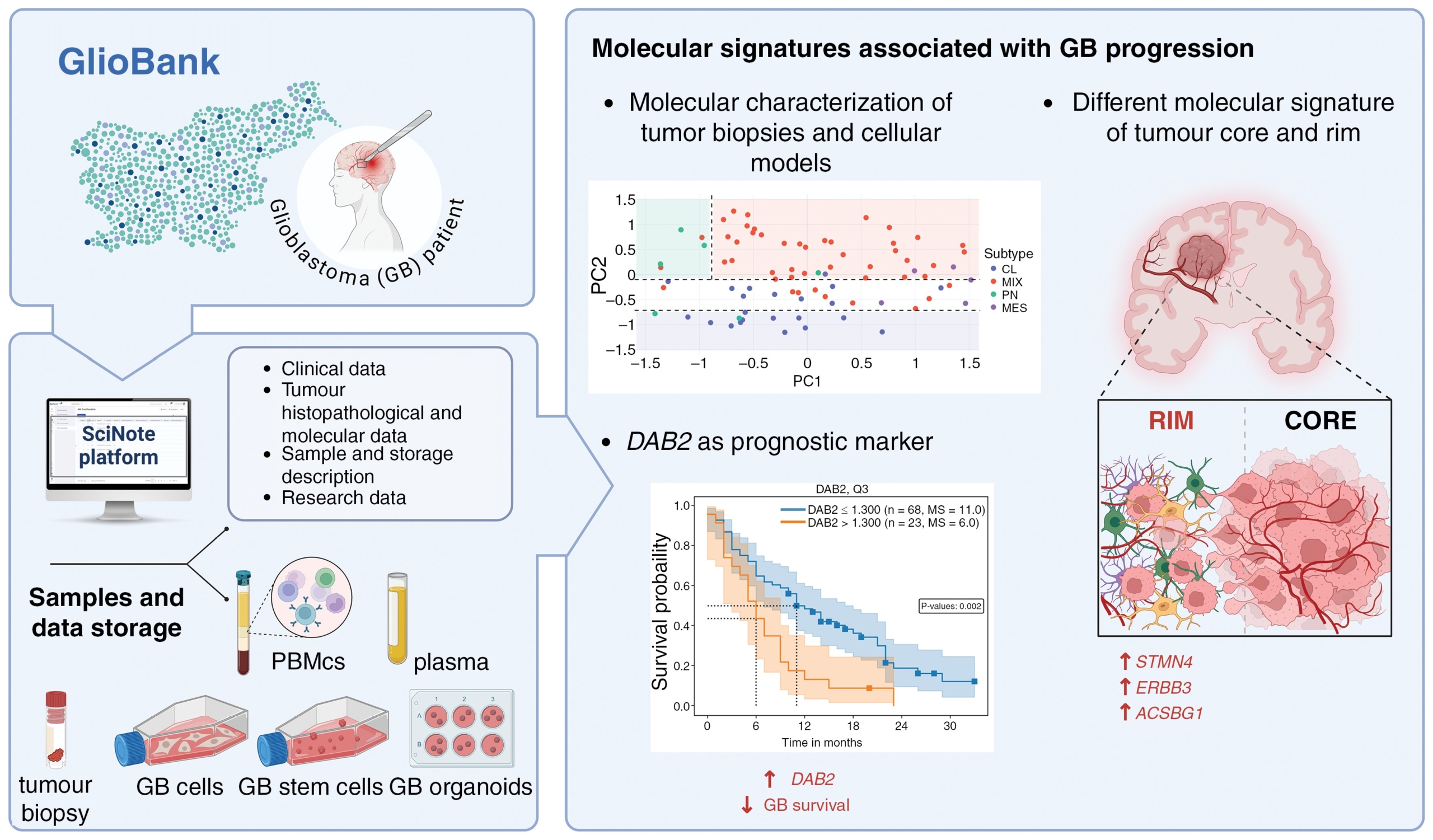
Figure: Graphical abstract of Gliobank project. The image is taken from the published article https://academic.oup.com/noa/article/7/1/vdaf015/7972534
Strength in Numbers: A Data Collaboration Blueprint
The GlioBank project is evidence that when biobanking workflows are digitally connected, institutions can overcome traditional obstacles of communication, data access, and biospecimen coordination and work together as a true translational working towards the same goal: contributing to a brighter future of glioblastoma patients.
This biobank system is not just about compliance. It’s about collaboration and long-term impact. With the help of SciNote the full story of each patient’s disease can be preserved to accelerate the understanding of this difficult disease from samples, images, and discoveries in one ecosystem.
From LN2 tank to molecular signature to published survival model, every critical dataset is managed in SciNote, unified in a secure ELN with inventory and LIMS-style capabilities.
Final Thoughts: Biobank Data Needs the Right Digital Infrastructure
Whether you’re managing a national biobank, running trial-based sample collections, or capturing in vitro GB models from patient-derived samples, your data infrastructure determines research agility, audit-readiness, and scientific impact.
SciNote is the ELN that makes your biobank smarter, your sample data traceable and safe, and your multidisciplinary team connected, compliant, and prepared for next-gen discovery.

Gain full control over your biobank operations.
A biobank-ready lab management solution provides clear visibility into samples, inventory, and processes, helping your lab stay organized, transparent, and compliant.